About the Green plastics factory
At The Green Plastic Factory, we imagine a future where rural India is not only clean and flourishing but also a beacon of sustainable innovation. We believe in a world where waste is not an end but a new beginning, where communities prosper, and nature flourishes. Our vision is to transform low-grade plastic waste into valuable products, creating a circular economy that benefits both people and the planet.
Our primary goal is to eradicate plastic pollution in remote villages and establish a self-sustaining model for waste management and employment. We aim to:
- Make remote villages plastic-free: By setting up a strong collection and recycling system, we intend to eliminate plastic waste from the outskirts of villages, preventing it from being burned or sent to landfills.
- Create meaningful employment: We provide training and job opportunities to young adults with special needs who have been dropout from the main stream education system. Our six-month training program equips them with the skills needed to run our machinery, manage plastic segregation, and handle production.
- Empower communities through education: We are committed to raising awareness about plastic pollution and the importance of recycling. Through workshops and outreach programs in local government schools, we educate children and, in turn, their families, about the environmental impact of plastic and proper waste segregation.
- Foster a collaborative ecosystem: We work with various partners, including local governments, NGOs, and corporations, to ensure a steady supply of raw materials and a wide-reaching impact.
- Educating the Next Generation
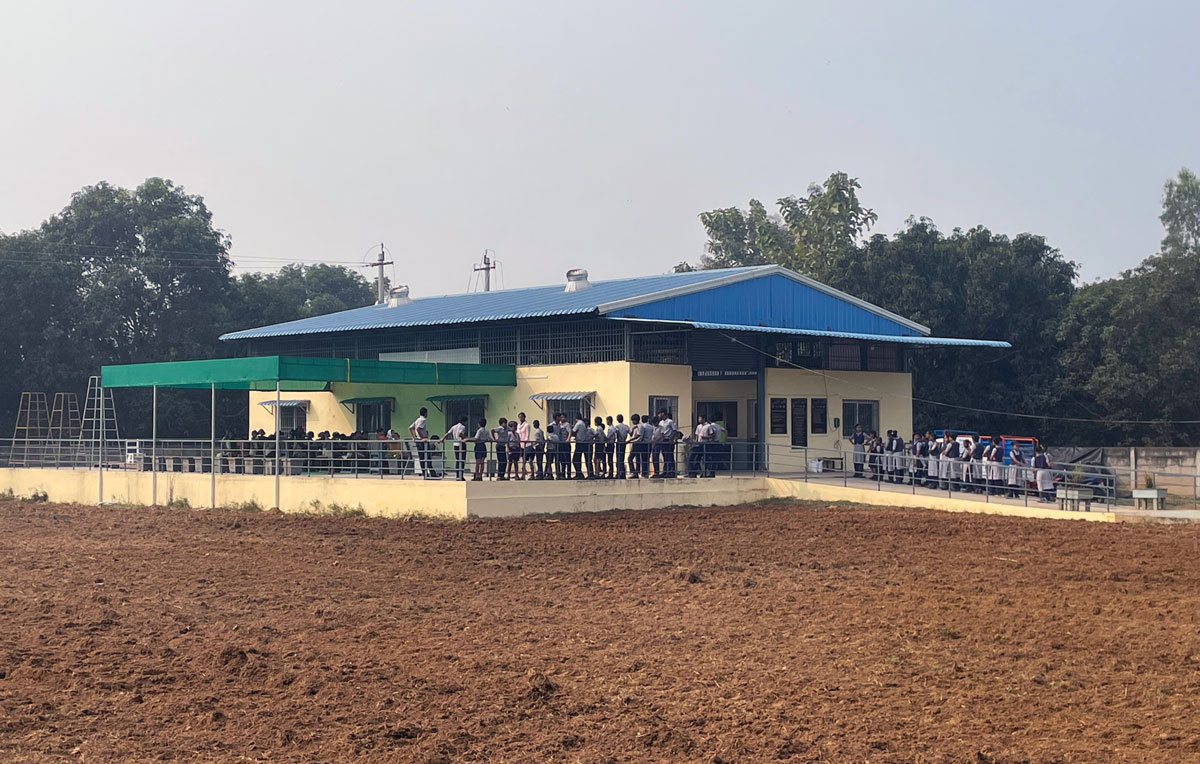
We believe that true change starts with education. Our program reaches over 5,000 schoolchildren across 10 villages, teaching them about the importance of recycling. These children become ambassadors of change, sharing their knowledge with their families and helping to create a culture of environmental responsibility
THE PROGRAM
The Green Plastic Factory is more than just a recycling facility, it is part of a larger social and environmental program designed to reduce plastic pollution, create meaningful jobs, and raise awareness.
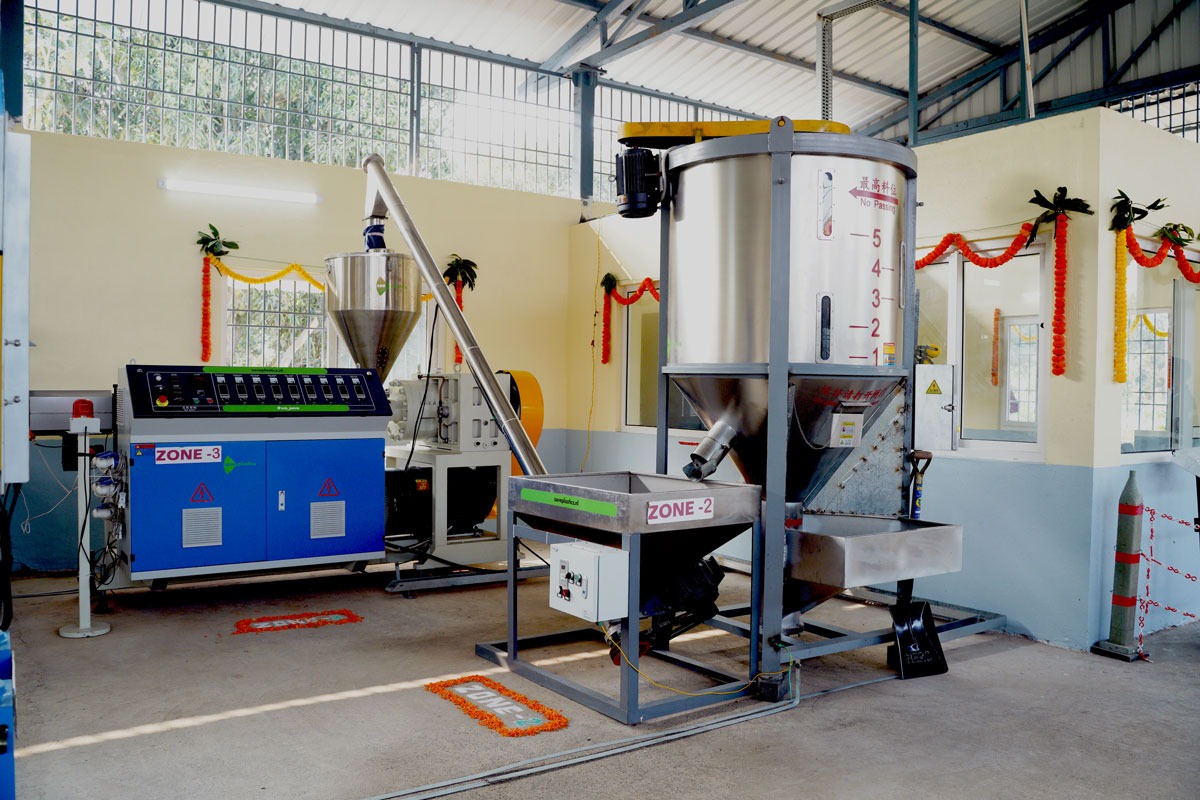
1 | The factory: planks and poles out of waterpouches and milk pouches
With a set of advanced machines, youngsters transform low-worthy plastic, like waterpouches and milkpouches, into strong tiles, planks. And poles. The tiles are very useful for paths, carports, garden. And with the planks and poles t is possible to make products for the garden like:
- Fencing
- Flowerpots
- Coffee tables
- Sofa’s
- Industrial pallets
We source our raw materials directly from the communities, creating a circular system that benefits everyone. Plastic waste is collected from 10 fishermen- and adjacent villages of Campus Challenge.
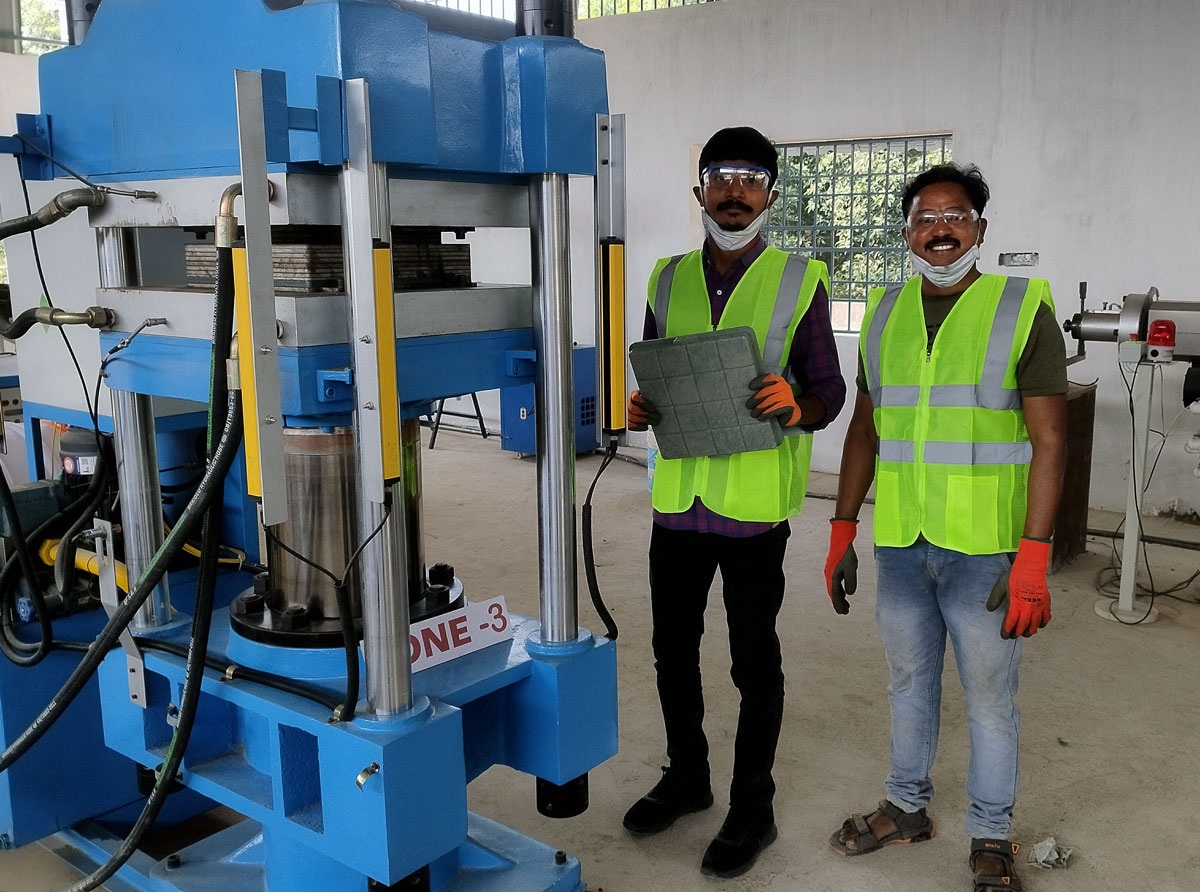
2 | Training to become a plastic recycle operator
Our program offers a lifeline to young adults with special needs. After a comprehensive six-month training period, they become certified and are guided toward future employment in similar industries, ensuring they have the skills and confidence to build a career.
Our training covers:
- Operating and troubleshooting machinery.
- Plastic segregation and selection.
- Production processes.
- Equipment maintenance.
- Proximately 5,000 households.
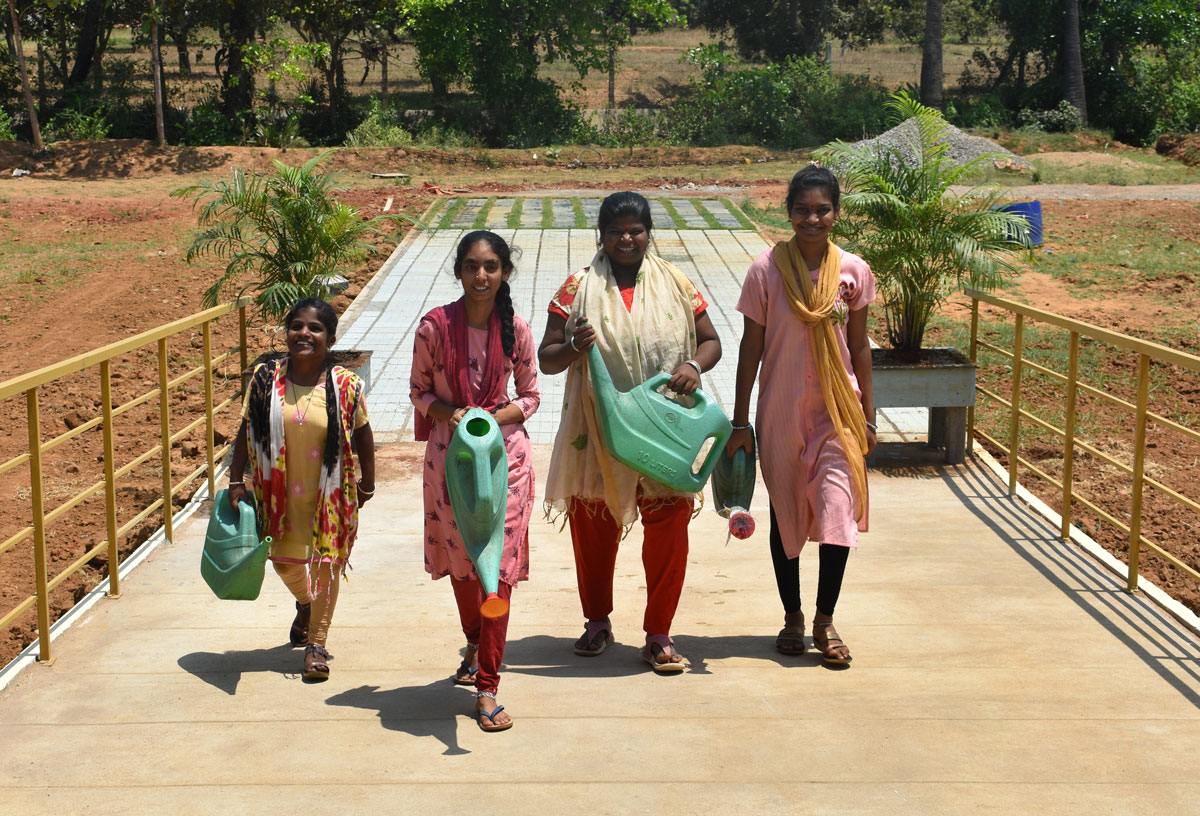
3 | Awareness program in 10 villages
In total 10 villages participate in this three- year program.
- Government schools, where students learn to collect and sort plastic waste.
- Panchayat sanitation workers and individual households participating in the initiative.
- Local companies that donate their food-grade plastic waste for recycling.
Recently, Rotaryclub Vizianagaram donated an electric auto to pick up the collected plastic waste!
The Partners
The Green Plastic Factory is a collaborative effort made possible by partners in India and the Netherlands. Each organisation brings unique strengths to support recycling, training and community impact.

Rotary International
The plastic program is initiated by Rotaryclub Amsterdam-Nieuwendam, Netherlands and Rotaryclub Vizianagaram, India. It is a three years program 2024 – 2026 under Global Grant nr. 2238142. The following participants are executing the program based on an MoU with Rotary International:
- Rotaryclub Amsterdam-Nieuwendam – The Netherlands
- Rotaryclub Vizianagaram – India
- Campus Challenge/Association Saikorian – India
- Save Plastics The Netherlands – The Netherlands
- Save Living the Netherlands – The Netherlands
- Friends Indeed, the Netherlands – The Netherlands

Campus Challenge for specially abled children and youth
A joint program by Friends Indeed and Association Saikorian
This green plastic recycle factory is embedded in the program Campus Challenge for children and youth with a disability. This Campus opened its doors in 2010, and is a unique and successful ‘4 in 1 program’, with a dedicated staff, reason why Rotary decided to start this plastic factory at its premises. This Campus has the following pillars:
- A children village with 10 houses for 150 children, accessible for wheelchairs and rollators
- An EMS school with classes 1 – 10, also fully accessible, with
3 classes special education for hearing impaired, visually impaired, deaf and mentally challenged children.
- Medical centre for the ambulant care for 850 children plus physiotherapy, audio therapy and a state of the art orthopaedic workshop.
- Vocational training for youth: stitching, administration, gardening, printshop and plastic recycle operator
The Campus is a joint program of the Friends Indeed Foundation and the Association Saikorian, founded by the alumni of the Sainek school in Vizianagaram, AP, India.
Save Plastics & Save Living
Save Plastics and its foundation Save Living work together to create a cleaner, fairer world — both environmentally and socially.
With over 35 years of experience, Save Plastics transforms low grade household plastic waste into high quality outdoor products such as benches, planks and decking. Their mission goes beyond recycling. They aim to reduce CO₂ emissions, prevent pollution and give people with fewer opportunities a fair chance through socially driven projects.
Save Living adds a strong social and ecological foundation. As a nonprofit, it supports initiatives that restore balance by investing in biodiversity, circular systems and inclusion. Together, they ensure that the Green Plastic Factory combines technical innovation with human impact.
Friends Indeed Foundation
Friends Indeed is a Dutch NGO, with programs in Andhra Pradesh, India, since 2001, under which 24 schools in 24 villages, followed by water- and sanitation programs, HIV program for children, micro credit for mothers, I learn to speak English programs, etc.
In 2008 the development of Campus Challenge started, based on the principles of the United Nation convention 2006 regarding persons with a disability. Friends Indeed is an ‘in and out’ fund: the Dutch donors fund per program. The director and/or board members of Friends Indeed visit twice per year for further development and monitoring. For the plastic recycle program, Friends indeed gave a guarantee for unforeseen costs, not under the umbrella of the Global Grant.
Coordinators of the program
The Coordinators are:
Rotary Amsterdam-Nieuwendam
Anne Legeland
Rotaryclub Vizianagaram
Dr. Venkateswararao
Campus Challenge/Association Saikorian
R.L.N. Sharma director Green Plastic Factory
P.N.S. Varma Chairman AS
Friends Indeed Foundation
Anne Legeland
Save Plastics
Bram Peters
Marlous de Bordes
Save Living Foundation
Marlous de Bordes
International coordinator who reports to Rotary International is Anne Legeland